The Kingdom of Morocco is a land of stunning contrasts—from the bustling souks of Marrakech and the ancient ramparts of Fes to the soaring dunes of the Sahara and the crisp beaches of Essaouira. If you hold a Tajik passport and dream of sipping mint tea in a Riad courtyard, this guide is your first step.
Getting your travel authorization sorted is usually the most stressful part of planning a big trip. Morocco eVisa for Citizens of Tajikistan. The journey to Morocco is straightforward, but it comes with a specific, and very important, condition if you want to use the convenient online eVisa system. We’ve broken down everything you need to know, from eligibility rules to processing times and travel tips.
Do Citizens of Tajikistan Need a Visa to Visit Morocco?
Yes, absolutely. If you carry a passport from Tajikistan, you are required to secure an official travel authorization before you arrive in Morocco. There is no option to just show up at the airport and get a visa at the border. Securing your visa in advance is mandatory for all Tajik travelers.
However, the question isn’t just if you need a visa, but how you can get it.
The good news is that you are eligible to apply for the Morocco eVisa system, which is the fastest and easiest way to secure entry, but only if you meet a specific, conditional requirement.
What Documents Are Needed for the Morocco eVisa?
The online application process is designed to be user-friendly, but you need to have sharp, clear digital copies of a few key items ready to upload.
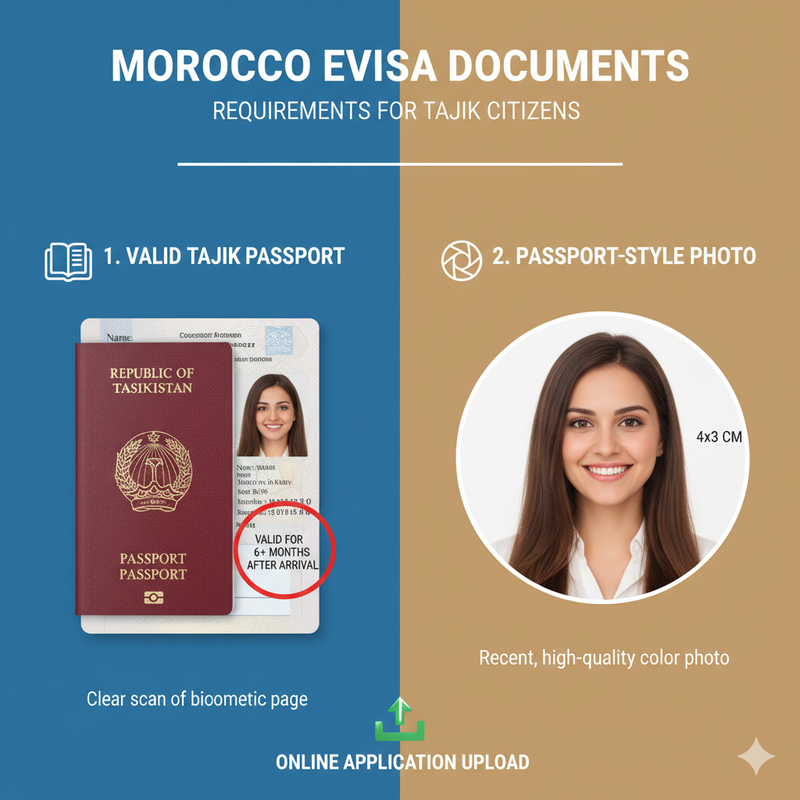
Morocco eVisa Documents Requirement:
- Your Valid Tajik Passport: A clear scan of the main biometric page. Your passport must be valid for at least six months beyond your intended date of arrival in Morocco.
- Passport-Style Photo: A recent, high-quality, color photo (typically 4x3 cm) with a plain white or light background.
Supporting Travel Documents:
You will also be asked to provide details or copies of your travel logistics:
- Confirmed Return Ticket: A copy of your flight booking showing you plan to leave Morocco within the permitted 30-day stay.
- Proof of Accommodation: This can be a confirmed hotel booking for your first few nights, or a letter of invitation if you are staying with friends or family in Morocco.
- Proof of Funds: While you don’t usually need to upload bank statements, you must confirm you have sufficient funds to cover your stay (often quoted as about 70 EUR per day).
How to Apply Morocco eVisa for Citizens of Tajikistan
How to apply for Morocco eVisa online and requirement, the application process is completely digital.
Step-by-Step Application Guide:
- Select Your Type: Choose between the Tourist eVisa or the Business eVisa. For a holiday, select the tourist option.
- Complete the Form: Fill out the application form carefully. You will need to input personal details (name, date of birth, passport number), as well as information about your travel dates and proposed entry point into Morocco. Double-check every detail—any small mistake can lead to delays or rejection.
- Upload Documents: Upload the required scans of your passport and your photograph. Ensure all scans are high-resolution and clearly readable.
- Submit and Await Confirmation: Once the application is complete and the processing contribution is made, you will receive an acknowledgment of submission via email.
It's highly recommended to apply for your eVisa well in advance of your travel date, just to be on the safe side.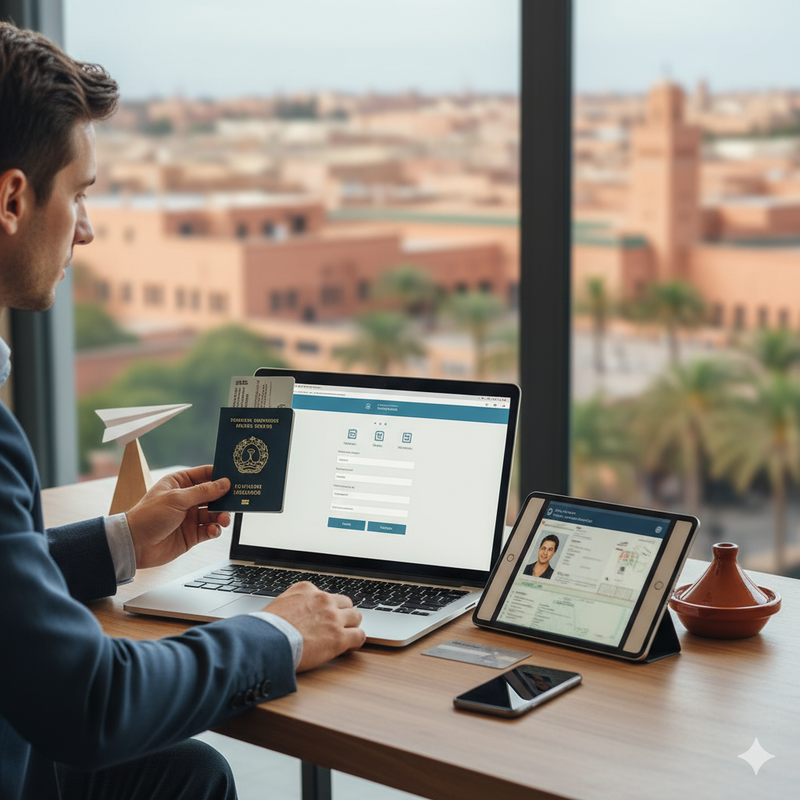
How Long Is the Morocco eVisa Valid For, and How Long Can You Stay?
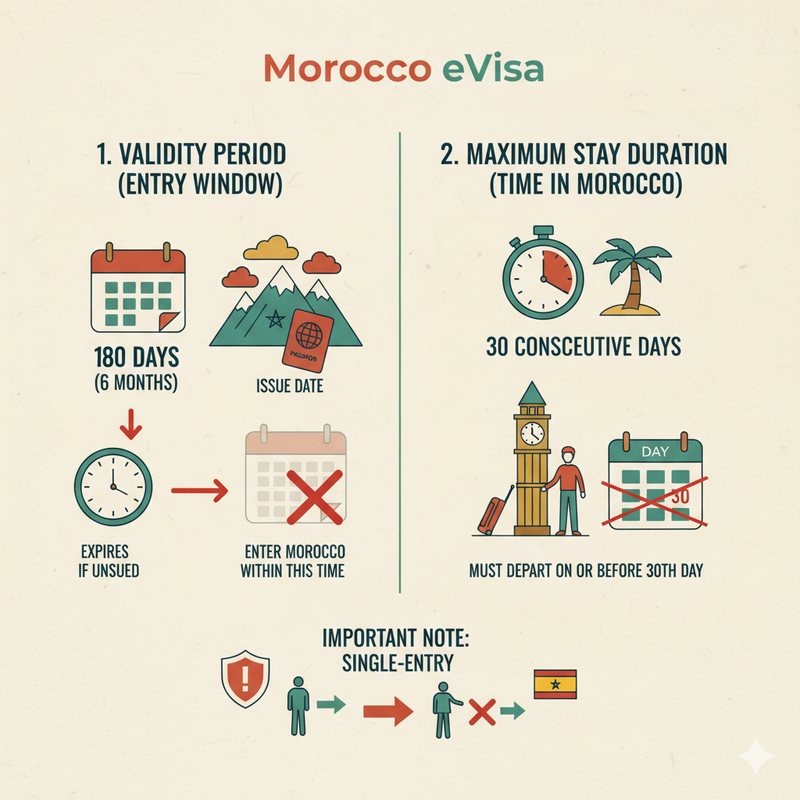
The Morocco eVisa for travelers from Tajikistan offers two distinct periods of validity you need to keep straight:
1. Validity Period (Entry Window)
Your approved eVisa is valid for 180 days (6 months) starting from the date it is issued. You must make your entry into Morocco sometime within this six-month window. If you don't use the eVisa within this time, it expires and becomes useless for travel.
2. Maximum Stay Duration (Time in Morocco)
Once you enter Morocco using your eVisa, you are permitted to stay for a maximum, single-entry duration of 30 consecutive days. This is a strict limit, and you must depart on or before the 30th day.
Important Note: The Morocco eVisa is a single-entry authorization. This means that if you use it to enter Morocco, then take a quick trip to Spain, and try to re-enter Morocco, you will need a brand-new visa for the second entry.
What Happens If I overstay the eVisa Validity or My Permitted Stay of 30 Days?
Overstaying any visa is taken very seriously by authorities around the world, and Morocco is no exception. It’s crucial to treat the 30-day limit as absolute.
If you remain in Morocco beyond the 30-day limit without securing an official extension, you are considered to be an illegal resident. The consequences can include:
- Financial Penalties: You will likely be required to pay a hefty fine for each day you overstayed before you are allowed to leave the country.
- Deportation: In serious cases, you could face administrative detention and immediate deportation.
- Future Travel Bans: Most importantly, having an overstay record will severely complicate your ability to obtain any future travel authorizations—not just for Morocco, but potentially for other countries as well.
If you absolutely need to stay longer than 30 days due to unforeseen circumstances, you must contact the local police services (specifically, the General Directorate of National Security) before your 30-day limit expires to request a formal extension, which can sometimes be granted for up to six months. Do not wait until the last minute.
How Long Does It Take to Process a Morocco eVisa?
The primary advantage of the eVisa system is speed. There are typically two options for processing:
Here are the options for Morocco eVisa Processing Times:
Standard Processing: 3-6 days.
Rush Processing: 2-4 days.
Super Rush Processing: 1–2 days.
Keep in mind these timelines are estimates for complete and correct applications. If you make an error, if a document is unclear, or if your application requires additional verification, the processing time will be longer. Always factor in a few extra days for unexpected delays.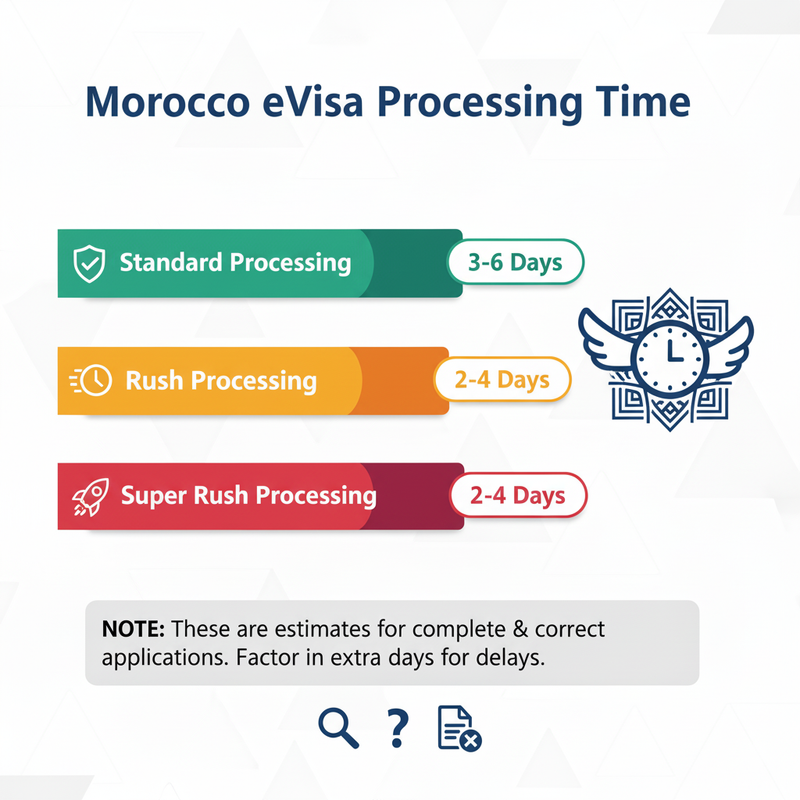
Can Minors (Under 18) Apply for the Morocco eVisa?
Yes, children and minors holding Tajik passports require their own separate eVisa, just like adults. The process is the same, but with one key difference in how the application is submitted:
- Application by Guardian: The application for any child under the age of 18 must be submitted and completed by a parent or legal guardian.
- Required Documents: You will need the child's own valid passport, a photo, and the parental consent forms or a copy of the parent/guardian’s legal identification to prove authority. If the child is traveling without both parents, an attested letter of consent from the non-accompanying parent may also be required.
Which Is Safer: Applying Through the Official eVisa Website or Using a Travel Agent?
Each of these strategies can be effective, and which one should you use depends on your level of comfort-however, they each have their benefits:
Applications will occur on the Official eVisa Portal.
- Direct
- Transparent
- Clear instructions
- Online provision of your travel permission.
Using a Travel Agent
- Guided assistance
- Convenient to people who do not know how to use online forms.
- Mentoring in case you have any issues uploading documents.
In case you are sure about using online platforms, it is easy and safe to apply directly. In case you want a hassle-free time, a reliable travel agent can take the load off.
Can I Convert an eVisa into a Residency Permit Later in Morocco?
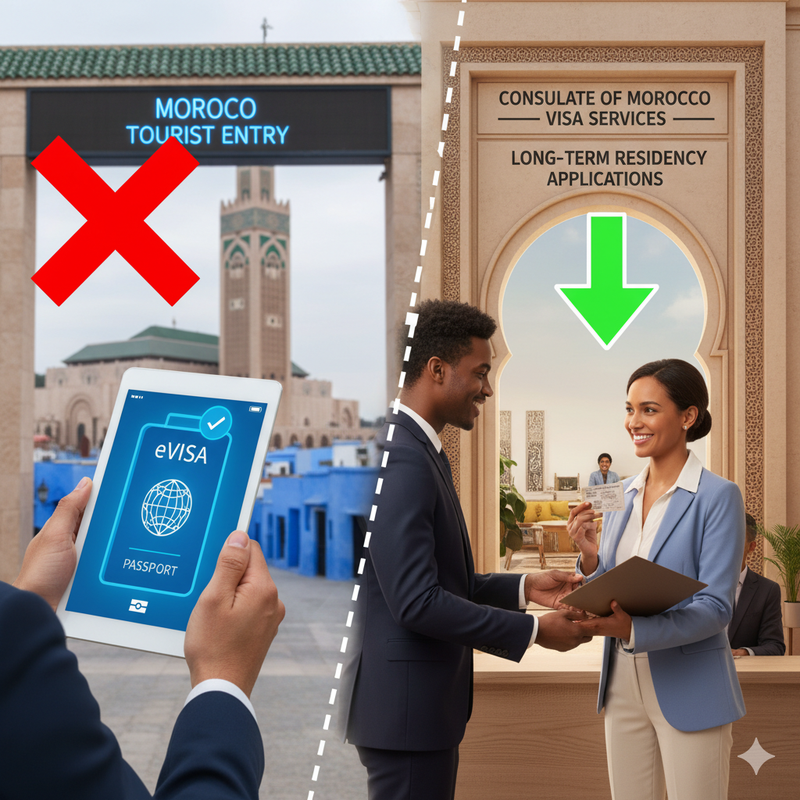
This is a frequently asked question, and the answer is generally no, with very few exceptions.
The Morocco Tourist eVisa (and other short-stay visas) is designed purely for short-term tourism, leisure, or business visits. It is a non-immigrant document.
If you decide while in Morocco that you wish to stay long-term—perhaps for work, study, or family reunification—you cannot simply convert your 30-day eVisa into a long-term visa or a residency card (Carte de Séjour).
To begin the process of obtaining legal long-term residency, you would typically need to:
- Depart Morocco: You usually must leave the country and apply for the appropriate long-term visa (like a Student Visa, Work Visa, or Long-Term Stay Visa) from outside of Morocco.
- Apply for a Long-Term Visa: These long-term visas are usually what allow you to apply for a residency permit after you enter the country.
What Passport Types Are Eligible for the Morocco eVisa?
The streamlined online eVisa is specifically designed for holders of ordinary passports (sometimes called regular or tourist passports) for tourism or short-term business purposes.
If you hold a diplomatic, official, or service passport, your travel authorization requirements are governed by different protocols. In these cases, you would need to contact the Moroccan diplomatic office directly, as the online eVisa platform will not be the correct pathway for your travel document type.
Is There a Morocco Visa on Arrival for Tajik Citizens?
No. This is perhaps the most important point for Tajik travelers to remember: Morocco does not offer a Visa on Arrival (VoA) for citizens of Tajikistan.
You must have your approved eVisa (or a traditional sticker visa) printed out and ready before you check in for your flight. Without a valid, pre-approved travel authorization, airlines will not permit you to board the flight destined for Morocco, even if you are just connecting through a major travel hub like Istanbul or Dubai. Do not risk it; plan and secure your eVisa ahead of time.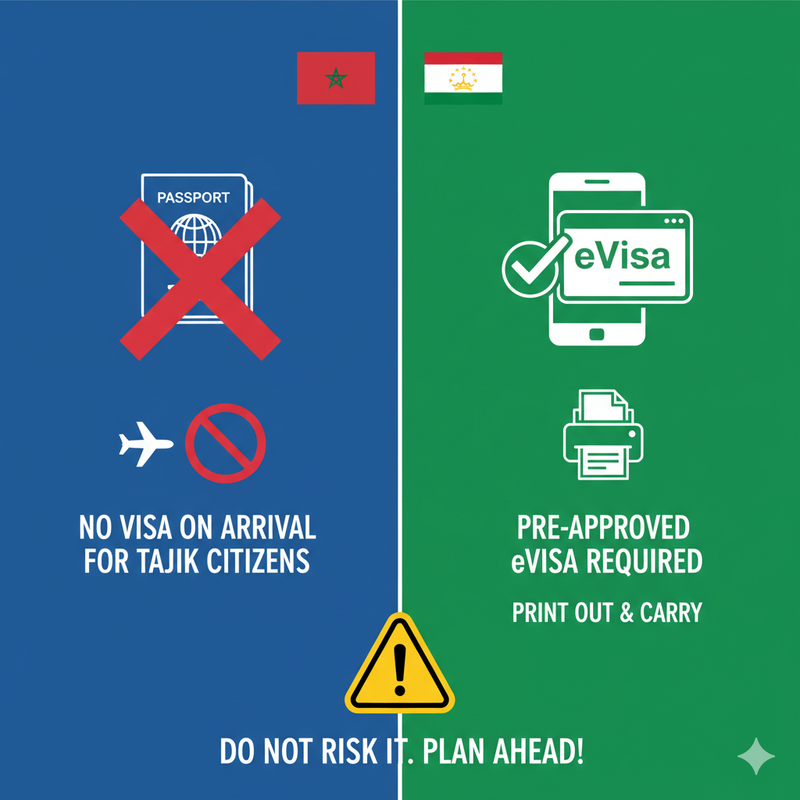
If My Morocco eVisa Is Rejected, Can I Reapply?
Yes, if your initial eVisa application is declined, you generally have the right to reapply.
Why Applications Get Rejected:
Rejections usually fall into two categories:
- Administrative/Trivial Errors: The most common reasons are simple mistakes: uploading a blurry passport scan, a mismatch between the name on the application and the passport, or forgetting to include proof of your return flight.
- Eligibility Issues: For Tajik citizens, a rejection might occur if your “Golden Ticket” visa is single-entry, has expired, or is valid for less than 90 days remaining.
What to Do After a Rejection:
- Analyze the Reason: Try to determine exactly why the application was refused.
- Correct the Issue: If it was a simple administrative error or a missing document, fix the problem immediately.
- Wait and Reapply: If you've corrected the error, you can submit a new application. However, if the rejection was due to ineligibility (i.e., you don't have the necessary supporting visa), reapplying via the eVisa platform won't change the outcome. In that scenario, you would need to abandon the eVisa route and proceed with the traditional physical visa application process at the accredited Moroccan diplomatic mission.

Travel Tips: Making the Most of Your 30-Day Moroccan Adventure
Once your eVisa is secured, you're ready to start planning the fun stuff! Morocco is incredibly diverse, and 30 days is the perfect amount of time to explore it.
- Master the Trains: Morocco has an excellent, modern, and affordable high-speed train network (ONCF) that connects major cities like Casablanca, Rabat, Kenitra, and Tangier. It’s the best way to cover long distances comfortably and quickly.
- Negotiation is a Skill: In the souks (markets) of Marrakech and Fes, negotiation is expected. Don't be shy! Start your offer at 30-50% of the asking price and work your way up. It’s a fun cultural exchange, not a confrontation.
- Embrace the Mint Tea: You will be offered Atay (sweet Moroccan mint tea) everywhere—in shops, hotels, and homes. Accepting it is a gesture of warmth and hospitality. Enjoy it, even if you’re not a huge tea drinker.
- Stay Connected: SIM cards for local providers are cheap and easy to purchase at the airport (e.g., Maroc Telecom, Orange). A local number will make navigating and arranging transportation much easier.
- Dress Respectfully: While Morocco is a welcoming country, remember to dress respectfully, especially when visiting religious sites. Loose-fitting clothing that covers the shoulders and knees is appropriate.
Morocco eVisa FAQs for Tajik Travelers
Q: Do I need a paper copy of my eVisa?
A: Yes, even though it’s an electronic visa, you absolutely must print a paper copy of the approval document. Present this along with your passport and your “Golden Ticket” visa when you arrive at the border control checkpoint.
Q: My "Golden Ticket" visa expires in 95 days. Is that enough?
A: Yes, but just barely! The requirement is that the supporting visa (e.g., Schengen, US) must be valid for at least 90 days from the date you submit your Morocco eVisa application. If it expires on day 95, you are eligible. However, for maximum peace of mind, it’s best if it has more than 120 days of validity remaining.
Q: Can I use the eVisa for a business trip?
A: Yes, when you apply online, you will select either the Tourist eVisa or the Business eVisa option. Both follow the same conditional eligibility rules for Tajik citizens, and both grant a 30-day stay within the 180-day validity window.
Q: What should I do if my passport is about to expire?
A: Get a new passport first. Your passport needs to be valid for at least six months from your date of arrival in Morocco. Applying with a passport that is near expiration will lead to certain rejection.
Q: My spouse is a Tajik citizen but holds an EU residence permit. Are they eligible?
A: Yes. If they hold a residence permit from any of the Golden Ticket countries (including the Schengen area countries), they are eligible for the eVisa, provided the permit is valid, multiple-entry, and has the required 90+ days of validity remaining. The Tajikistan passport is simply the primary travel document; the residence permit is the key to eligibility.
With your "Golden Ticket" document in hand, the process of securing your Morocco eVisa is quick and simple. Now you can stop worrying about paperwork and start focusing on practicing a few phrases in Darija (Moroccan Arabic) and dreaming of those spice-scented adventures!
Comments